Today, to start the new month, I made my FTMO account to start a trial (obviously no challenge yet, just the trial).
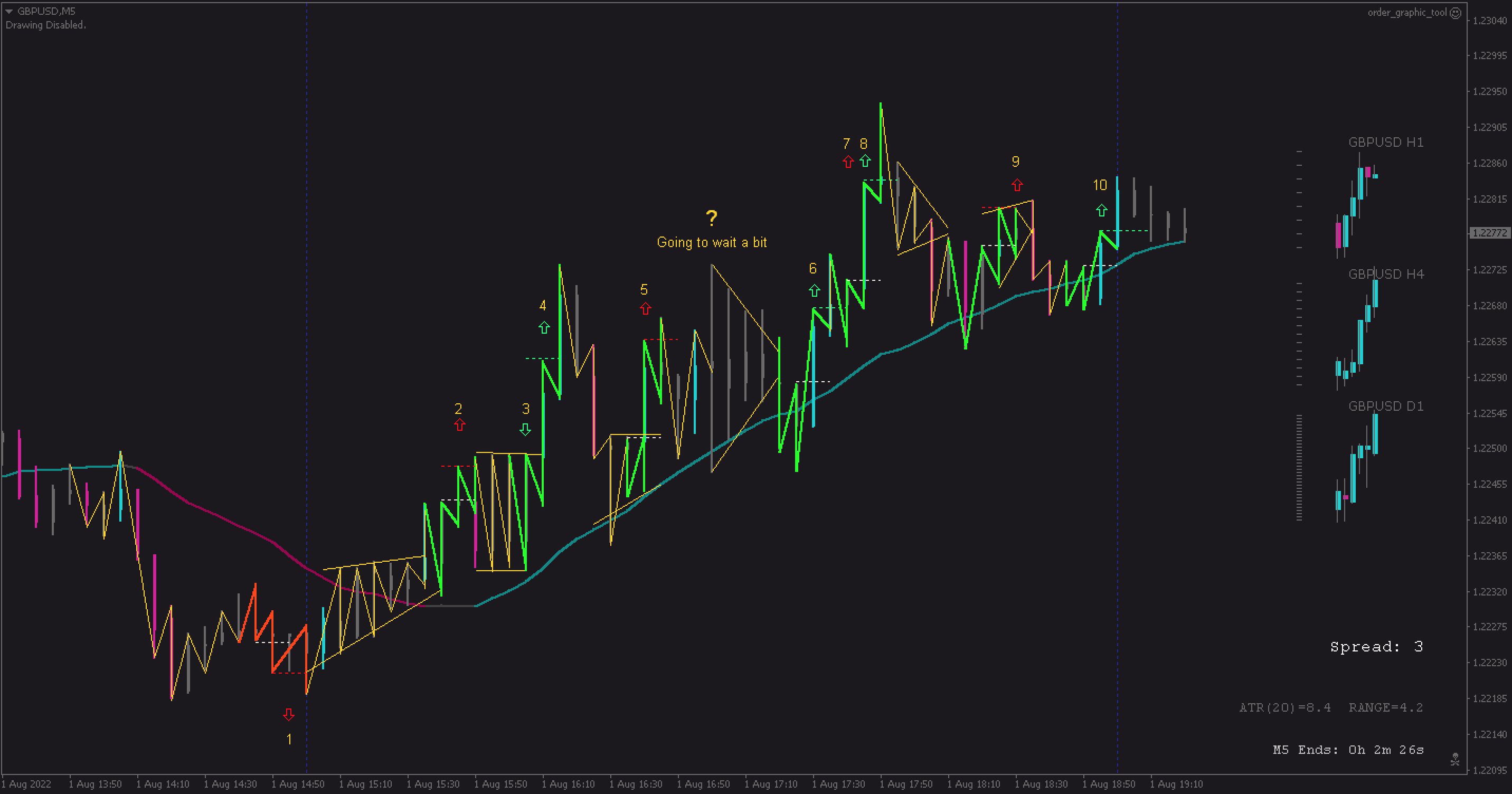
10 trades, 5W and 5L, and total was -1% due to costs. I had a few 'doubts' with some of the trades but decided to take them anyway.
Quick notes: trade #3 was taken for other reasons, there was a range of 4 bars in a row with a range of 15 with the same highs and lows, and took a short. Wouldn't to it again though. Trade #7 was a re-entry because I barely got wiggled out of the pullback and still looked good, but wouldn't have done it again if it failed again.
When comparing the trades, I noticed 2 things.Instead of just comparing winners and losers (which is the outcome) I decided to compare the trades based off a criteria I noticed, and then see what the outcome was, like doing it the other way around. The criteria is if the pullback before break #2 went over the break #1 or not.
Trades 1(L), 2(L), 9(L), all had the pullback before break #2 go past break #1.
All 3 of those trades were losers. No winners.
Trades 4(W),5(L),6(W),7(L),8(W),10(W) didn't have the pullback of break #2 go past break #1. 4 of those were winners and 2 were losers.
On all four of the above winning trades, there was room to get at least 2:1 instead of 1:1. Going over one of my recent posts where I talked about the small pullbacks on larger momentum candles. The only reason I didn't target a 2:1 is because I had a few losing trades and didn't want to make it worse so I was conservative.
Now I don't want to say 'I should have or shouldn't have done X and should've been a +7% instead of a -1% day', but there is definitely something to some trades that make them better than others. For the sake of experimenting I'll keep taking these but only to test if the length of a pullback is worth noting to avoid getting into some bad trades. As an observation, this is also true if I look at the continuation of reversals for shorts (that I don't take because of the long bias), but it still applies there and can be seen on today's session.
And it seems that when the pullback is strong, then it makes more sense to take a bounce instead of waiting for price to get back to BO#2; it would provide larger RR but that would mean anticipating 1 step of the pattern. So that's for another time, I don't want more variables for now lol.
The way I've been following price like this makes total sense to me, I think I just need a tweak or two and I might be good to go (hopefully)

So to keep it short:
1) Start comparing the size of the breakout vs the size of the pullback to see if a trade is crap.
2) Let it run a bit more if the breakout was done with good momentum and has a small pullback to have better RR when that happens.
- GU_08012022_1.png (204.79 KiB) Viewed 1629 times
Unrelated note on the HTF to LTF stuff: There is a logistics issue because those trades might take more time to develop, so maybe a few entries until I get it right and that it requires more follow through, if using an H4 how 'small' should I go for the entries, and so on. So I think I need to figure some things to make it work.







